Large Language Model (LLM) Cheat Sheet
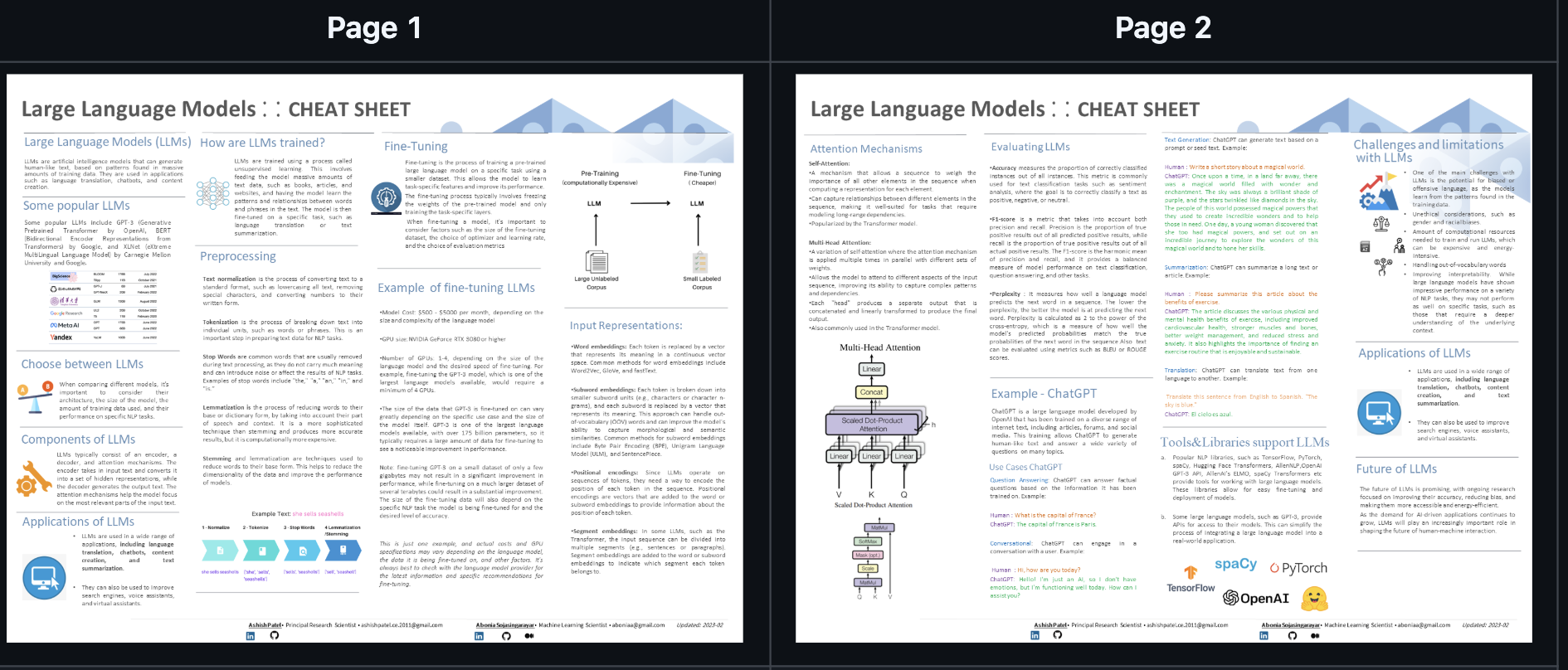
The LLM (Large Language Model) Cheatsheet is a quick reference guide that provides an overview of the key concepts and techniques related to Natural Language Processing (NLP) and language modelling.It is designed to be a helpful resource for both beginners and advanced practitioners in the field of NLP.
Reading_time: 5 min
Tags: [Large Language Models, LLM, Generative AI, Artificial Intelligence, Machine Learning, Natural Language Processing, NLP, Deep Learning, Transformers, GPT, Language Models, AI Engineering, Fine-tuning, Tokenization, Embeddings, Neural Networks]
- Download the cheatsheet
- Introduction
- Purpose
- Key Concepts
- Tools and Libraries
- Topics Covered
- Format
- How to Use This Cheatsheet
- Conclusion
Download the cheatsheet
Introduction
Large Language Models are a type of machine learning model trained on vast amounts of natural language data.
They use deep learning algorithms to learn patterns in the data and can generate human-like text, translate between languages, and perform a wide range of other tasks.
Purpose
The purpose of the LLM Cheatsheet is to provide a quick and easy-to-use reference guide for NLP practitioners.
It covers a wide range of topics related to language modelling and provides a high-level overview of the most essential concepts and techniques in the field.
These models are designed to process natural language data and perform various tasks, including:
- Text generation
- Translation
- Sentiment analysis
- Question answering
- Other NLP tasks
Key Concepts
Some key concepts to understand when working with Large Language Models include:
1. Preprocessing
The input data must be preprocessed before training a language model.
This involves:
- Cleaning the text
- Tokenizing text into individual words or subwords
- Encoding data into a format that can be processed by the model
2. Fine-tuning
Large language models are often trained on large datasets, but they can also be fine-tuned on smaller, domain-specific datasets to improve their performance on specific tasks.
3. Generation
Language models can generate text by predicting the next word or token in a sequence, or by sampling from a distribution of possible outputs.
4. Translation
Language models can be used for machine translation by encoding text in one language and decoding it into another language.
5. Sentiment Analysis
Language models can be used for sentiment analysis by predicting the sentiment of a piece of text, such as whether it is positive, negative, or neutral.
Tools and Libraries
There are many tools and libraries available for working with Large Language Models.
Some popular options include:
TensorFlow
An open-source machine learning framework that provides tools for building and training large language models.
PyTorch
An open-source machine learning framework that is widely used for natural language processing tasks.
Hugging Face Transformers
A library that provides pre-trained models for a wide range of natural language processing tasks, along with tools for fine-tuning and generating text.
OpenAI GPT-3
A pre-trained language model capable of generating human-like text, answering questions, and performing various language tasks.
Topics Covered
The LLM Cheatsheet covers the following topics:
- Language modelling basics
- Types of language models
- Preprocessing and tokenization
- Word embeddings and vector representations
- Transformer and GPT architectures
- Training and fine-tuning language models
- Evaluation metrics for language models
Each topic is presented with concise, easy-to-understand explanations and examples.
Format
The LLM Cheatsheet is a single-page PDF document that can be easily printed or saved offline.
It is designed to be visually appealing and easy to navigate, with a clear and consistent layout.
How to Use This Cheatsheet
The LLM Cheatsheet can be used in various ways:
Quick Reference Guide
Use it as a quick reference when working on NLP projects or researching language modelling techniques.
Study Aid
Use it as a study aid to help learn and remember key concepts and techniques in NLP and language modelling.
Teaching Tool
Use it as a teaching tool to introduce students to the basics of language modelling and NLP.
Conclusion
The LLM Cheatsheet is a valuable resource for anyone interested in Natural Language Processing.
It provides a clear and concise overview of the essential concepts and techniques related to language modelling.
Large Language Models are a powerful tool for working with natural language data. By understanding key concepts and using the right tools and libraries, you can build and fine-tune models that can perform various tasks.
This cheat sheet provides a starting point for working with these models and exploring their capabilities.
If you find this useful, please ⭐ star the repository and contribute.
Thanks for Reading!
Website/Newletter AIMagazine Substack
Connect with me on Linkedin
Find me on Github
Visit my technical channel on Youtube
Support: Buy me a Cofee/Chai